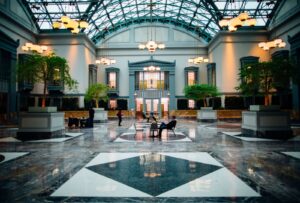

I stood in a university lobby for the better part of an afternoon watching people walk up to our machine. What I saw changed the product. Guests would approach confidently, reach the front of the booth, and then stop for a beat or two longer than made sense. Some walked away. When I asked people afterwards whether anything had been unclear, every single one said no. A self service photo booth lives or dies on that gap between what users say and what they do, and the only way to find it is to stand back and watch.
The hesitation problem
Self service is an old and well studied idea, running from petrol pumps to supermarket checkouts, and the pattern is consistent across all of them. People will use an unfamiliar machine if the first action is obvious within a couple of seconds. Beyond that they start looking for a person, and if no person exists they frequently leave.
Our hesitation was not about the photographs or the payment. It was about which thing to press first. The screen had a start control and it was perfectly visible, yet it did not announce itself as the thing you touch. Guests were waiting to be told, and nobody was there to tell them.

What the machine has to communicate in four seconds
Four things, in order, and all before a guest has committed to anything.
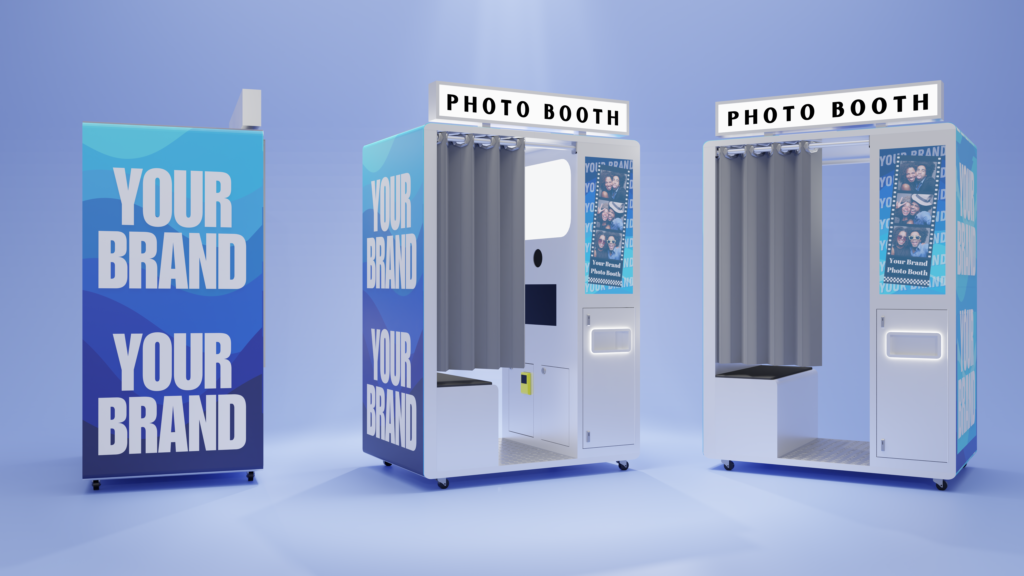
- What this is. The cabinet shape does most of this work, which is a good argument for the classic form.
- That it is working. A dark or static screen reads as broken even when the machine is perfectly healthy.
- What it costs. Hidden pricing kills more sessions than high pricing does.
- What to do first. One unmistakable action, not a menu.
Miss the last one and the other three do not matter. We had the first three right from day one and still lost sessions, which is why the fix was worth a week of attention.
Designing a self service photo booth for someone who has never seen one
The temptation is to explain more. Almost always the correct move is to explain less and show more.
Our monthly giveaway is a good example of getting this wrong. It is a genuinely useful mechanic, since a guest posts their strip, tags the venue and enters a draw, and every entry is an authentic post naming the location. However, the wording on screen was far too long to read while standing about in a busy lobby. People started reading, gave up, and moved on. So the instructions are being cut rather than the mechanic.
That pattern repeats everywhere in self service. Copy that reads fine on a desk fails on a machine, because the reader is standing, possibly holding a drink, possibly with friends waiting, and giving you a fraction of the attention you imagined.
Planning a machine nobody will stand next to? We build for exactly that, and we have made most of these mistakes already. Ask us for a quote.
What we changed, and what happened
We put a prompt on the opening screen a few days into that first week. The hesitation stopped. That is the whole change, and it was worth more than any hardware decision we made that month.
For context, the machine took upwards of three hundred paid sessions in its opening month across twenty five operating days. The strongest weekday by a clear margin was Friday. Volume concentrated heavily around the busiest period of the term and then settled, which is exactly what you would expect and is worth saying out loud, because a first month number without that caveat encourages people to plan badly.
The two things guests praised repeatedly were camera quality and print speed. Neither is a self service feature as such. Both matter enormously to self service anyway, since a guest standing alone waiting for a print has nobody to talk to while they wait.
Self service photo booth versus a person with a camera
Operators weighing the two models usually compare cost first, which is the least interesting difference. These are the ones that actually change outcomes.
| Self service machine | Staffed booth | |
|---|---|---|
| Hours available per week | Whenever the venue is open | The hours you are booked |
| Cost per session | Consumables and processing only | Consumables plus labour |
| Guest inhibition | Low, nobody is watching | Higher, especially sober crowds |
| Recovers from a fault | Only if designed to | Instantly, a person fixes it |
| Learns from guests | Through data, slowly | Through the attendant, immediately |
| Scales by | Adding sites | Adding staff and weekends |
That fifth row is the hidden cost of self service and it deserves respect. An attendant notices confusion instantly and adapts. A machine notices nothing, so somebody has to go and watch it, which is precisely the afternoon described at the top of this page.
Where self service genuinely wins
Staffed booths do some things better and it is worth being clear about which.
A staffed booth handles a wedding, where groups are large, the schedule is compressed and somebody needs to herd people. It also handles brand activations, where the point is often a conversation as much as a photograph.
A self service photo booth wins wherever the machine has to be available for months rather than hours. It wins on cost per session by an enormous margin, since there is no labour at all. Furthermore it wins on guest willingness in a specific and underrated way: some people will happily pull a face inside a closed booth who would never do it with an attendant watching.
The privacy point nobody mentions
This is the argument I find most persuasive and it rarely appears in comparisons. An enclosed self service machine gives guests something no staffed setup can, which is genuine unobserved privacy. Nobody is watching, nobody is directing, and the results show it.
Guests kept asking whether the booth was permanent, then reacting with real enthusiasm on being told yes. My reading is that permanence signals it is theirs to use whenever, rather than something set up for an occasion they need to perform for.
Frequently asked questions
How do you test whether a guest flow works?
Stand where you cannot be seen and watch strangers use it. Interviews will tell you it is fine when it is not.
Does a self service machine need signage around it?
Some, though far less than people expect. If the machine needs a poster to explain it, fix the machine.
What happens when a guest gets stuck mid session?
It should time out and reset itself to a clean start screen. A machine holding somebody else’s abandoned session is a machine nobody else will approach.
Do guests treat unstaffed machines badly?
Less than we feared. A machine that looks permanent and cared for gets treated accordingly.
Get a cabinet designed around the guest, not the spec sheet. Tell us the room and who walks through it. We will quote it.
The software side is covered in unattended photo booth software, and the full first month writeup is in our first month report. Venues who would rather host than buy should read permanent photo booth installation.
The engineering behind an unattended machine sits in what makes one run without staff. On payment specifically, there is coins against contactless.