
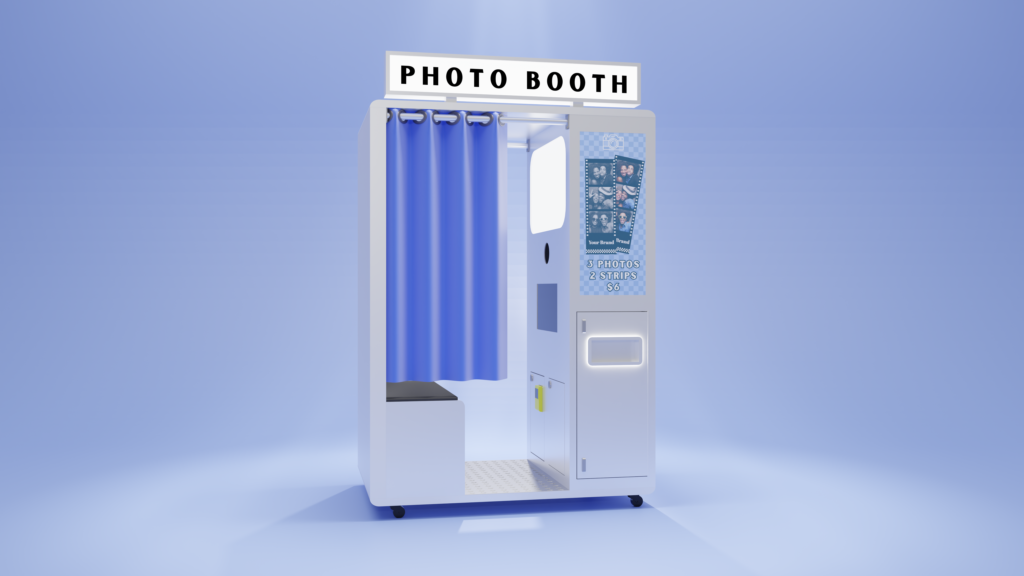
Does it work when nobody is standing next to it? That is the only question separating a photo booth kiosk from an ordinary photo booth, and almost everything else follows from the answer. A kiosk takes its own payment, explains itself to a stranger, prints without prompting, and tells somebody when it needs paper. Consequently the engineering effort goes into the situations a human would normally absorb: the failed card, the confused guest, the empty roll at midnight.
What actually makes a booth a kiosk
Self service machines are a well established category, and photo booths are latecomers to it. The interactive kiosk pattern shows up in parking garages, airports and laundromats, and the design constraints are identical. Four capabilities do the work.
- Unattended payment. A terminal built to authorise, settle and refund with nobody present, rather than a phone reader that expects a human to tap accept.
- A guest flow that survives no instruction. If a first time user needs telling what to do, the machine is not finished.
- Remote visibility. Somebody has to know the paper ran out before the venue calls to complain.
- Recovery without a visit. The machine should get itself back to a working state after a crash, a power cut, or a network drop.
Miss any one and you do not have a photo booth kiosk. Instead you have a booth that needs a person, which is a different business with a different cost structure.
The jobs an attendant quietly does
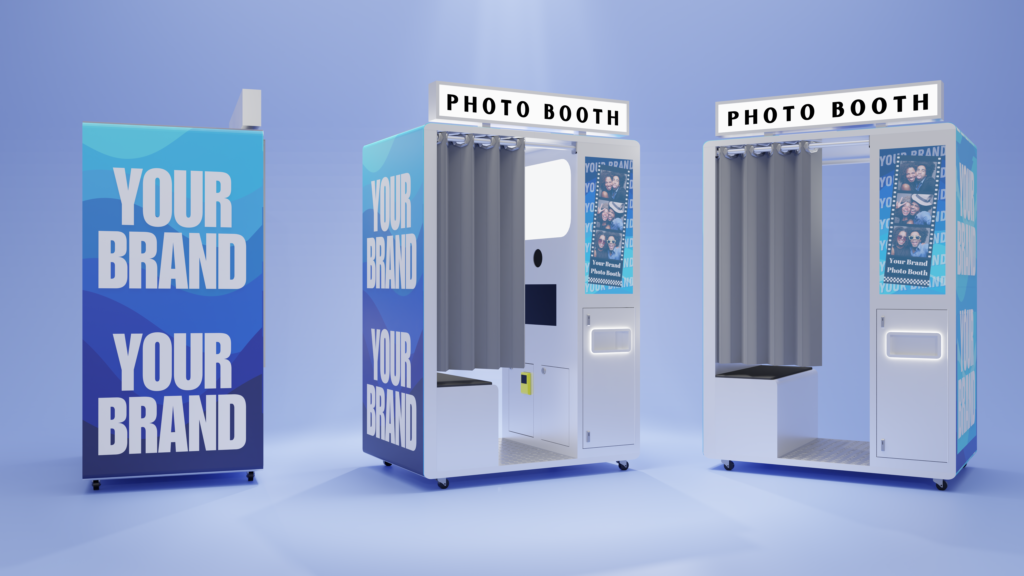
Watch a staffed booth at an event and the attendant looks idle. They are not. They are doing four things that a kiosk has to replace in software and hardware.
First, they start people off, because guests hesitate at an unfamiliar screen. A declined card gets sorted before it becomes an abandoned sale. Snagged strips get cleared out of the paper path. Finally the machine gets reset between groups, so the next guest meets a clean start screen instead of somebody else’s countdown.
That third one is the hardest. Paper paths are mechanical, and mechanical things jam. A kiosk cannot unjam itself, so the design goal shifts to making jams rare and making the recovery obvious to whoever is nearby.
Thinking about an unattended machine rather than a staffed one? Tell us the room and we will tell you honestly whether a kiosk suits it. Request a quote.
Where kiosks genuinely fail
I would rather say this than have you discover it. Our first machine went into a university building in August 2026, and it was not flawless.
Twenty sessions had to be refunded after a fault in the first few weeks. Twenty more card attempts never authorised at all. Set against upwards of three hundred paid sessions that month, neither figure is catastrophic. Both are real, though, and any manufacturer promising perfect uptime in the field is either new or not being straight with you.
We got the guest flow wrong at first, too. People paused over what to press. Asking them about it surfaced nothing; standing at a distance and watching surfaced it within minutes. Guidance went onto the opening screen partway through that first week, and the pause disappeared. A separate monthly giveaway underperformed because its instructions ran too long for somebody standing in a lobby, so those are being cut.
Choosing where a kiosk goes
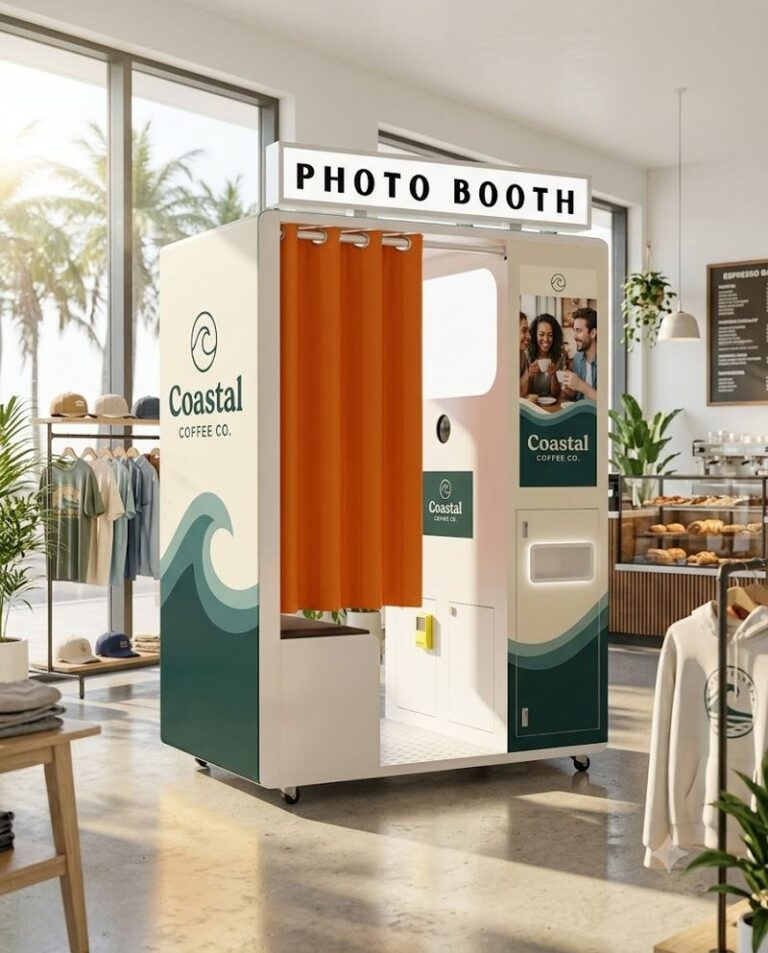
Site selection does more for revenue than any feature. So far the pattern is straightforward. A kiosk needs to be visible from wherever people already stand still, yet out of the path of anyone carrying something.
Lobbies, landings beside lifts, and the wall a queue faces all work. Corridors do not, because nobody stops in a corridor. Meanwhile a spot behind a door or around a corner underperforms regardless of how good the machine is. A self service machine cannot advertise itself to somebody who never sees it.
Power and a reliable network matter too, although less than people assume. Visibility beats everything.
Kiosk or staffed booth: which fits what you are doing
Neither model is better in the abstract. They earn in different ways, and picking the wrong one is expensive in ways that only show up around month three.
| Photo booth kiosk | Staffed booth | |
|---|---|---|
| Revenue pattern | Small amounts, continuously, for months | Large amounts, on booked dates |
| Labour per session | Effectively none | An attendant for the whole event |
| What limits growth | Number of good sites | Number of staff and weekends |
| Worst failure | Machine sits dark and nobody notices | Attendant does not turn up |
| Who carries the risk | You, continuously | You, per booking |
The line that matters most is the last one in the growth row. A rental business grows by adding weekends and people, which gets harder every time. Meanwhile a kiosk business grows by adding sites, and a site does not call in sick.
Against that, kiosks punish bad placement in a way rentals never do. A rental that goes to a quiet wedding still gets paid. A kiosk in a quiet corridor earns nothing for a year while its costs keep running, which is why we are fussy to the point of irritating about where a machine goes.
What guests actually said
Two compliments came up repeatedly: camera quality and print speed. Guests called it simple, which they clearly intended as a compliment. Perhaps most usefully, a number of them asked whether the booth was permanent, then reacted with obvious enthusiasm on being told yes. That question is the earliest signal of repeat use we have found. A rented machine at an event never gets asked it.
Frequently asked questions
How often does an unattended machine need visiting?
Driven by print volume rather than by a calendar. Paper and ribbon set the rhythm, so a busy site needs attention more often than a quiet one.
What happens if the network goes down?
A well built machine keeps taking sessions and syncs afterwards. If a booth stops working because the internet blinked, that is a design failure rather than an outage.
Can venue staff be trusted to clear a paper jam?
Sometimes, and it should never be required. Our own arrangement is that we handle the machine and the venue is not responsible for it.
Is unattended riskier in terms of damage?
Less than expected so far. A machine that reads as permanent gets treated as furniture rather than as a target.
Get a straight answer on whether your site suits a kiosk. Send us a photograph of the space and rough footfall, and we will come back with a view and a price. Get in touch.
More on the software side in unattended photo booth software, and on hosting rather than owning in permanent photo booth installation.
The guest side of the same problem is covered in designing for a stranger. What happens when a kiosk stops working is in what breaks and who fixes it.