
Miami Spice is doing exactly what it was designed to do. From August 1 through September 30 it fills South Florida dining rooms during the deadest weeks of the year, and Dine Out Lauderdale runs the same eight weeks for Broward. What the flyer does not mention is that a prix fixe menu caps what a full room is worth to you. A photo booth for restaurants is one of the few things that earns inside that cap, because the guest pays for it rather than the house. A single session fee, agreed with you up front, two printed strips, nothing added to your check.
Two things are true at once here and most write-ups only manage one of them. The machine is a draw in its own right, something guests walk toward on purpose and bring people back to. It also happens to absorb the part of the visit you were never getting paid for anyway. The rest of this is about whether your room is the kind where both of those land, because plenty are not, and I will name the ones that are not further down.
What a discount month actually does to your average check
A prix fixe promotion trades margin for volume on purpose. You accept a lower check to get bodies through the door in August, betting that a slice of them come back in January at full price. That is a reasonable bet. Still, for eight weeks your food revenue per seat is fixed by a menu you already printed, so in practice the only variables left are drinks and whatever else happens around the meal.
Bar spend is the obvious lever and most operators are already pulling it. The less obvious one, meanwhile, is the stretch of the visit where the guest is not spending anything at all.
Why the front of the house is the right spot
The machine is an attraction before it is anything else. Guests notice it, decide they want the photo, and walk over on purpose. That is the whole engine, and everything else follows from it.
So the real question is where the most people will see it. In a genuinely busy restaurant, that is the area around the host stand, because a crowd forms there on its own. I have watched people wait thirty to forty minutes for a table in exactly that spot. For example, some talk, some step outside and come back, and some give up and eat down the block. That last one is the expensive outcome, and every operator already knows it.
What I got wrong about rentals
Rentals never touched this problem. Somebody books a rental for a private event and pays for it directly, so in other words it only shows up on nights you have already closed to the public.
I got that wrong for a long time. For months I walked into venues offering to split my rental profit with them for referrals, and it went nowhere. Then a manager told me they already had a photo booth, and pointed at a machine guests were paying for themselves. That machine inverted my whole model. A venue does not want to buy entertainment and then go market it. It wants something in the room that pays for itself and gives people a reason to stay put.
The pull is what makes it work. Guests use it once, then come back later with the people they want in the photo, and that repeat draw is what keeps earning long after the novelty has gone. A guest four minutes into something they chose to do is also a lot less likely to walk down the block, though that is a side effect rather than the point.
If you want to see what the machines actually look like, they are on the equipment page. For a placed machine running in the wild, we published the session numbers from our first week at Nova Southeastern University, and how that partnership came together.
What a photo booth for restaurants looks like when it is not a rental
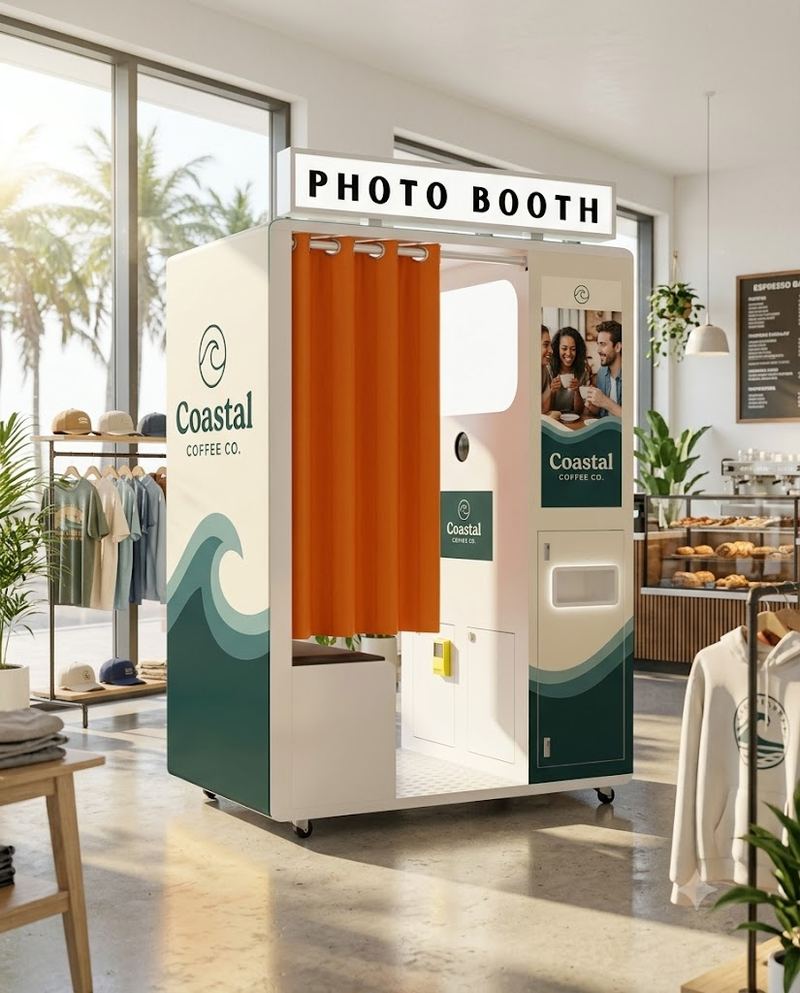
Placement and rental are two different businesses that happen to share a word. Under a placement agreement the machine goes in permanently, the operator owns it, services it, keeps it loaded with paper and covers the sales tax on sessions. As a result you are not booking anything and there is no invoice. Instead you give up roughly twenty square feet and a standard outlet, and you take a share of every session that runs.
| Event rental | Permanent placement | |
|---|---|---|
| Who pays | The host or the venue | The guest, per session |
| How long it is there | One night | Ongoing |
| Who staffs it | An attendant somebody is paying for | Nobody |
| Who markets it | You promote the event | It gets used because it is there |
| What a failure costs | An occasion that cannot be rerun | One guest out a single session fee, refunded |
That last row is the reason I stopped building my business around events. A party happens once. If a machine dies at a wedding you can return the money, but you cannot give the night back, so every single event had to be personally supervised. As a result hiring was almost impossible and scaling was worse. In a restaurant the identical failure costs one guest the price of a session and a refund. Nobody’s memory gets damaged.
Selfie stations, booth ideas and printed strips
Search around for restaurant photo booth ideas and most of what comes back is decor. A backdrop, a ring light, a tablet on a stand, a sign asking people to tag the restaurant. Those are cheap and they work for about a month, which in most cases is roughly how long the staff keep pointing at them.
The difference with a print booth is the object the guest leaves holding. When I moved from a 360 booth to a printing booth, the print booth was immediately the bigger hit and it was not close. People want something tangible. A photo on a phone is one of four hundred photos on that phone. The strip, by contrast, goes on a fridge and stays there for years.
A selfie station is free for the guest, which sounds like an advantage until you notice that free things get ignored. In fact something a person pays for out of pocket is something they decided they wanted, and that decision is most of the reason they treat the print as worth keeping.
Not sure whether your room qualifies? We build our own machines and place them across Miami, Fort Lauderdale and Palm Beach under the SmileMore name. Tell us what your Friday night looks like and we will tell you straight whether it is a fit.
The crowd this works for, and the one it does not
Here is where I talk myself out of some business.
This does not belong in a fine dining room. If your guests are there for an anniversary or a quiet, serious dinner, a booth is noise in a room that sells the absence of noise. Meanwhile the same machine in the right room barely needs explaining. I would rather say that on my own website than waste an hour of your evening finding out.
What I am looking for is a loose room. Somewhere people are eating and drinking heavily and treating the place as a social spot rather than a stop for food. That covers more ground than it sounds like, so here is the range as I actually think about it.
Rooms with a real line at the door
Louie Bossi’s when the patio is full. Rocco’s Tacos on Las Olas. Earls Kitchen and Bar on a weekend. These have the wait, the group tables and the drink volume. Here the booth earns mostly off people who were already standing there.
Rooms where the food is close to a side dish
El Camino on a Friday night is the obvious one. Grails up in Wynwood is another, where a party brunch with a live DJ is the actual product and the menu supports it. In these rooms the machine competes for attention instead of filling a gap. That is a higher bar, and a better payoff when it clears.
Rooms that flip after eleven
Kiki on the River is a restaurant until roughly eleven and a full party after. Marion in Brickell runs the same arc. A booth in a room like that gets two entirely different crowds out of one install. That is the closest thing to free money in this business.
The far end of the scale
Then there is somewhere like Senor Frog’s. The atmosphere is already the entire product, and nobody needs convincing that a photo belongs in the night.
Those rooms are wildly different from each other. Still, they share a short list. A wait at the door. A drinking crowd. Guests who have their phones out before anyone suggests it.
Breweries, sports bars and anywhere with a patio queue tend to fit for the same reasons, which is why the same argument runs for a photo booth in a bar. Cafes and counter service usually do not, because the visit is short and there is no wait worth filling. This is also the same problem as standing out when you cannot compete on price, approached from the operations side instead of the marketing side.
None of this is a new idea, incidentally. The 2026 restaurant coverage is full of activity-led dining and competitive socializing, and the mechanism everyone cites is dwell time. Guests who stay longer order more. What that coverage keeps missing is that the same attraction pulling people across the room is also covering the twenty minutes before they sit down, and you are not choosing between those.
Rooms differ, and so does the answer. Our permanent photo booth installation in Florida page sets out what a placement requires from the venue.
Common questions
What does a restaurant pay for a placed photo booth?
Under a placement agreement, nothing. The operator builds and installs the machine, services it, restocks it and covers sales tax on the sessions. The restaurant supplies floor space and an outlet, and takes a share of the revenue the machine produces.
What is the average cost for a photo booth?
For the guest, a single session fee for two printed strips, set with the venue, which is the figure most placed machines run at. For the restaurant under placement there is no purchase price, because ownership and maintenance stay with the operator. Buying a machine outright is a different business entirely and it is not what this arrangement is.
Where should it go in a restaurant?
Near the wait, not near the food. In other words the host stand area, the bar overflow, or wherever people stand holding a drink before they are seated. By contrast, a booth tucked past the restrooms gets used by people who already decided to use it, which is a much smaller number than the people who see it while they have nothing else to do.
Does this work for a cafe or fast casual spot?
Usually not. After all, the visit is too short, there is rarely a real wait, and the crowd is not in a mood to stand still for ninety seconds. A photo booth for restaurants needs a room people linger in by choice, and a counter with a pickup shelf is not that room no matter how much traffic runs through it.
I have emailed hundreds of restaurants and most never write back. That is the honest state of it, and it does not bother me much, because in the end the rooms actually worth placing a machine in are a narrow slice of the ones I contacted. If your dining room is quiet, or romantic, or turns a table in twenty minutes, you are not in that slice and I would be wasting your time pretending otherwise. If your host stand has people standing around it on a Friday with drinks in their hands and half an hour to kill, that is a different conversation, and it is the only one I am trying to have.
If you want to run these numbers for your own dining room, here is what we ask of the venue and what you keep.