
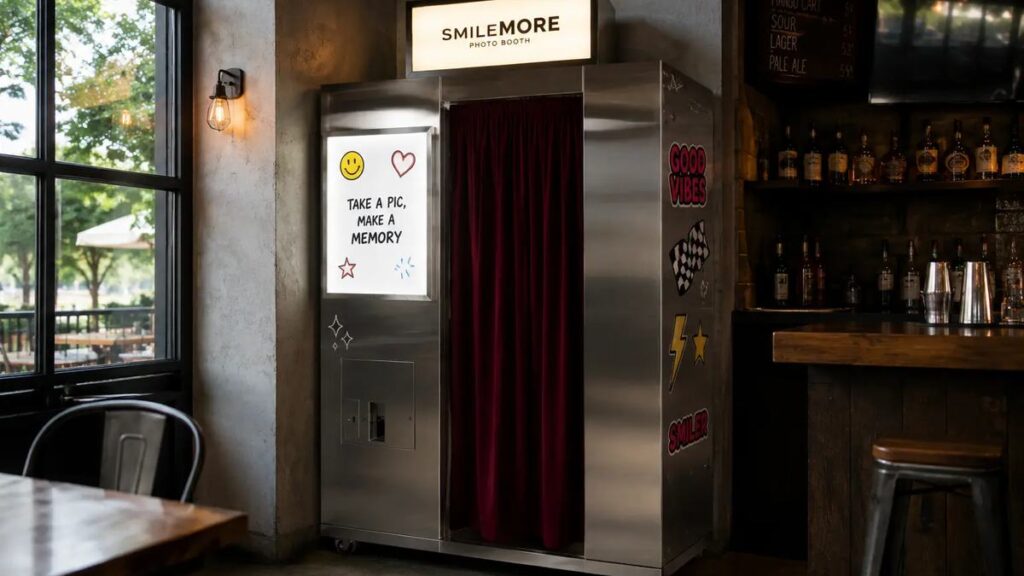
A photo booth for bars usually costs the owner nothing. A placement company builds the machine, installs it, services it and keeps it stocked. Our full breakdown of how a permanent photo booth installation works covers the build, the timeline and what the venue actually has to provide. You give up about twenty square feet and take a cut of every session. Guests pay a single session fee, set with the venue during review, and get two printed strips, often with your logo on them. That is the whole model, and it has been running quietly in bars, breweries and clubs for years.
What nobody explains is the difference between a good deal and a bad one. Most owners I talk to have never been told what to ask. They negotiate the percentage, sign, and then learn what the service terms actually mean the first Saturday the machine goes down. So here is the version I would want if I were sitting on your side of the table.
What “placement” actually means
There are three ways a booth ends up in a bar, and they are not close to equivalent.
You buy it. You pay for the machine outright, usually several thousand dollars, and you keep all the revenue. What comes with it is a small hardware business you did not ask for: paper jams, a dead printer, a camera that stops focusing, software updates, and the fact that nobody on your staff wants to be the photo booth person at 1am. Most owners who go this route end up with an expensive object in the corner that stopped working in March.
You lease it. A monthly fee, and you keep the revenue. Better than buying if you want to test the idea. Worse if the room turns out to be wrong for it, because the fee does not care how many sessions you did.
Placement, or revenue share. You pay nothing. The operator owns the machine and carries the maintenance, the consumables and usually the sales tax. You get a percentage of what it earns. This is the one that makes sense for almost every bar, because it turns an equipment decision into a floor space decision, and floor space is a decision you already know how to make. It is also the model we run, so treat what follows as informed and interested rather than neutral.
Does this work for restaurants, pubs and nightclubs too?
Yes, and the contract terms below are identical. What changes is where the machine goes and how much it earns.
A nightclub is the highest-volume case and the most demanding one, because the booth has to survive a crowd and still work at 1am. Pubs and neighbourhood bars do fewer sessions but produce more repeat use, since the same regulars come back and make a new strip. In a restaurant, almost all of it comes off the wait for a table, which makes placement near the host stand matter more than anywhere else. Breweries and taprooms sit in between and skew earlier in the day.
If an operator quotes you the same expected session count regardless of which of those you run, they are guessing.
The revenue split is just the cherry on top
Every owner I talk to negotiates the percentage first. I understand why, and I think it buries the actual point.
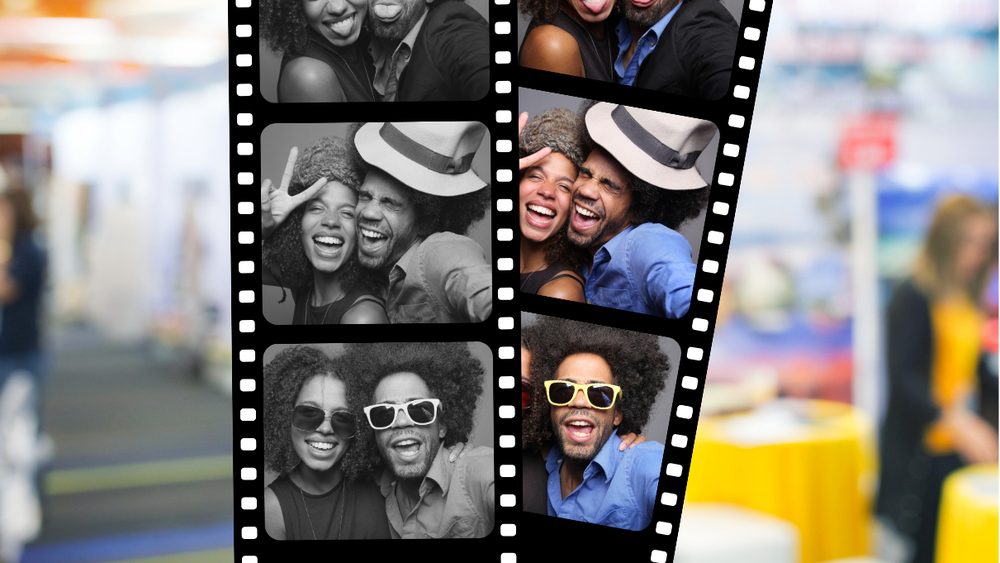
Strip the money out for a second and look at what the machine does while it sits there. Every session prints two pieces of card with your name on them. One of them leaves in somebody’s pocket and ends up on a fridge, in a wallet, or stuck to a mirror in an apartment three towns over. That is out-of-home advertising your guests are paying you to run, and it stays in circulation for months.
A good share of them get photographed and posted. Not by an influencer you paid, but by a regular whose friends look a lot like your customers, tagged at your bar, with your logo in frame. There is no version of that you can buy for the price of a photo booth.
Then there is what it does to the room itself. Activity-based entertainment has grown sharply since 2021 across pubs, bars and nightclubs, and the competitive socializing trend is now reshaping what a night out is expected to include. The reason is not complicated. People do not go out to drink. They go out to have something happen. A booth gives a group a reason to stand up, a reason to pull in the two people at the next table, and a reason to still be in your building forty minutes later. What happens forty minutes later is another round.
Why it keeps working after the novelty wears off
A photo booth is the rare amenity that produces something different every single visit. Your jukebox is the same jukebox. The photo on the wall is the same photo. The strip from tonight is not the strip from last month, which is why people bring different friends back to make a new one.
That monthly check is real, and it is nice, and it is the smallest item on that list. Treat it as the cherry on top. If the split is the reason you say yes, you are evaluating this as a vending machine, and it is not one.
Which leads to the practical version of the same point. Negotiate the terms that decide how often the thing gets used, because the percentage only divides whatever is left after those decisions are made. A generous share of a machine nobody touches is worth nothing.
Where it goes matters more than what you are paid
Most owners want the booth near the entrance. I understand the instinct and I think it is wrong.
People walking in have not had a drink yet, they are scanning for their friends, and they are not in the mood to be photographed. They walk past it. Later, when they would actually use it, they are seated across the room and have forgotten it exists.
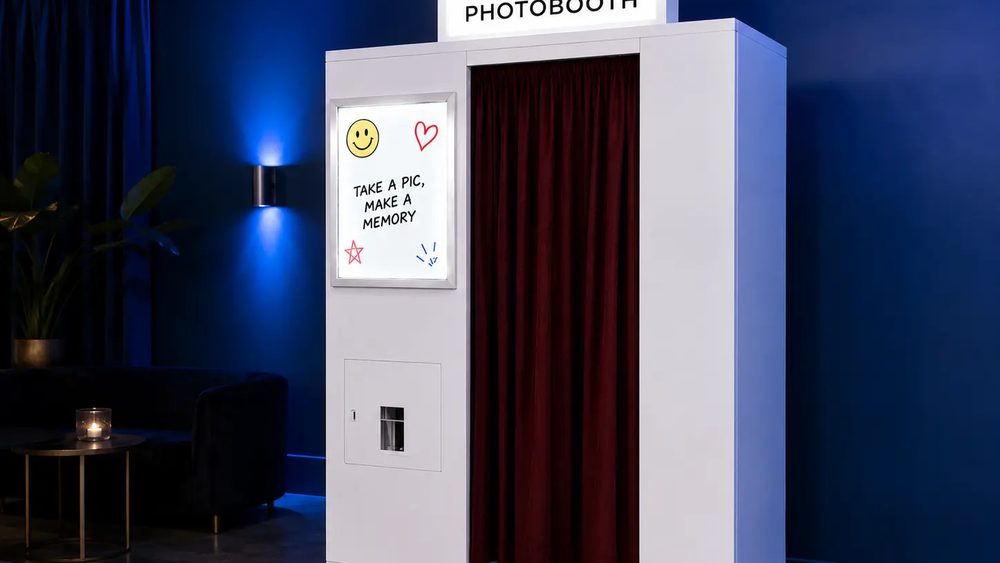
The corridor to the restrooms is better, for a boring reason: everybody walks it, most of them walk it more than once, and they are already up and moving. You are not asking anyone to make a special trip. Second best is anywhere a line naturally forms, because a queue is just people standing still with nothing to do.
Three things worth settling before you agree to a spot:
- The booth should be visible from at least one seated area, or people forget it is there.
- It needs a standard outlet within reach, which sounds obvious right up until you are quoting an electrician.
- It should not sit anywhere your staff have to squeeze past it carrying something.
What to compare when two companies pitch you
Assume the percentage is roughly similar across serious operators. These are the terms that actually separate them.
| Term | What you want | Red flag |
|---|---|---|
| Contract length | Short enough to exit if the room turns out to be wrong for it | Multi-year with no early termination |
| Exclusivity | Fine to grant, if it is mutual within your area | They lock you in and place three more booths on your block |
| Service response | A named window, in writing, that covers weekends | “We’ll get out there” with no timeframe |
| Consumables | Operator supplies and reloads the paper | Your bartenders are expected to do it |
| Reporting | Session-level data you can see yourself | A number in an email once a month, unverifiable |
| Branding | Your logo on every strip at no cost | Branding treated as an upsell |
| Guest data | Clarity on who owns the emails and photos, and whether you get access | Silence on the topic |
| Removal | They take it out at their cost, on reasonable notice | You pay to get rid of it |
Service response is the line I would push hardest on. A booth that breaks Friday and gets fixed Tuesday has cost you the only three nights that mattered, and it has cost you them in guest experience, not just in session count.
Want this checked against your actual room?
Send me a photo of the space and I will tell you whether a booth belongs in it, including if the answer is no.
The questions I would ask
- How many sessions does a booth in a room like mine typically do in a week?
- Who physically comes out when it breaks, and how fast, on a Saturday?
- Can I see live session data, or do I take your word for the total?
- Does my logo go on every strip, and who designs it?
- What happens if it underperforms? Can either of us walk away?
- Who is liable if a guest damages it, or if it damages my floor?
- Do you handle the sales tax on session revenue?
- Can I move it if the spot turns out to be wrong?
If an operator gets uncomfortable around the fourth or fifth question, that tells you more than any pitch deck will.
Common questions
Does a photo booth for bars cost the venue anything?
Under a placement agreement, no. The operator owns the machine and covers installation, maintenance, paper and usually the sales tax. The venue provides floor space and power, and receives a share of session revenue.
How much space does a photo booth need?
Roughly twenty square feet, plus room for a short queue to form without blocking a walkway. A standard wall outlet within reach is the only utility requirement.
Who owns the photos and guest emails?
It depends entirely on the contract, and it is the term operators are most often vague about. Ask directly whether you get access to the email list a booth collects inside your venue, and get the answer in writing.
What happens if the booth breaks on a weekend?
That is the term that matters most and the one least often specified. Insist on a named response window that explicitly covers Friday and Saturday nights, rather than a general promise to come out.
Where we stand
We build the machines ourselves and place them under the SmileMore name across Miami, Fort Lauderdale and Palm Beach. We are early. Our first campus installation goes in shortly, and I would rather say that plainly than imply a track record we have not earned yet.
What that gets you: you deal with me, not a territory rep, and the terms are still flexible because we are building the playbook rather than defending one. What it costs you: I cannot yet hand you a list of ten owners to call. If that is a dealbreaker it should be, and there are established operators who can.
Either way, use the questions above on whoever you talk to. The rooms that get burned on this are almost always the ones that only negotiated the percentage.
For a real example of what that looks like in practice, we published the session numbers from our first week at Nova Southeastern University, including what guests told us and what we changed mid-week.
Two follow-ups worth reading alongside this: how our first permanent machine went into Nova Southeastern University, and the same argument written for restaurants.
When you are ready to put us through the same questions, here is what we ask of your bar and what you keep.