

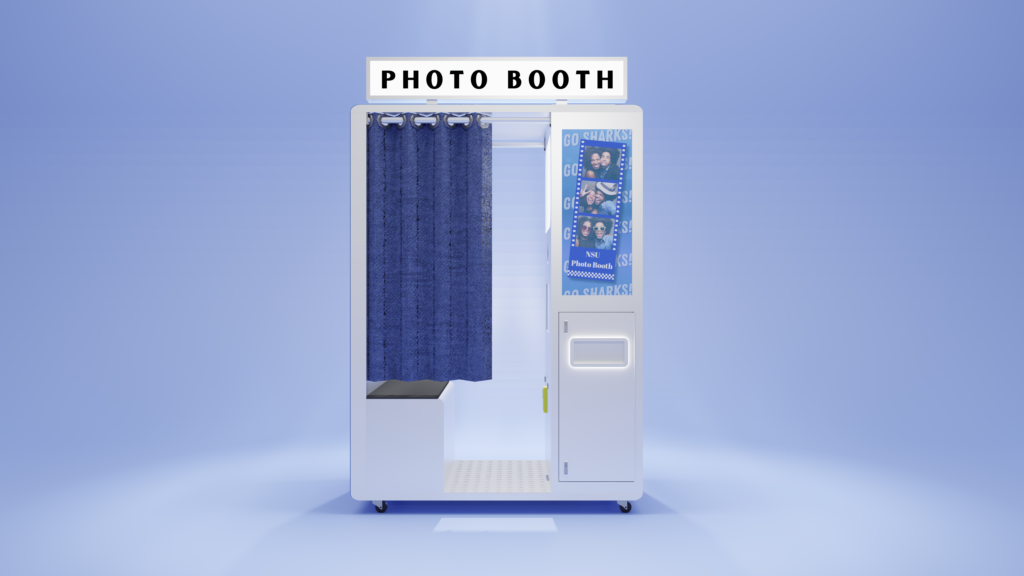
The biggest risk in any used photo booth for sale is not the hardware. Steel does not rot in a storage unit and cameras rarely die sitting still. What kills these purchases is the software licence and the payment terminal, because both can be dead on arrival, neither appears in a photograph, and together they can cost more to replace than the machine did. We build and sell new machines, so weigh what follows accordingly. Even so, plenty of used purchases work out, and the ones that fail tend to fail in the same few ways.
Why these machines reach the market
Any used photo booth for sale has a reason behind it, and that reason tells you most of what you need. In practice there are two common stories and they lead to very different machines.
An operator leaving the business sells a working unit. It was earning until recently, the consumables are current, and the seller can tell you what it did last month. These are usually good buys and they move quickly.
The other story is a machine that stopped working and never got fixed. Often the trigger was small: a licence lapsed, a processor changed terms, a printer failed just as the owner lost interest. Then it sat. Since the seller frequently does not know which small thing it was, you are buying an unsolved problem at an unknown price.

Four checks before any money moves
- Run a full session in front of the seller. Payment through to printed strip. Not a demo mode, a real transaction on a real card.
- Establish who owns the software licence and whether it transfers. Ask for the vendor’s name and call them yourself.
- Identify the payment terminal and its processor. Terminals get retired, and a discontinued model cannot simply be reactivated in your name.
- Check consumable availability for that exact printer. A media size nobody stocks locally turns every reorder into a special order.
The first check catches nearly everything. Sellers who resist it are almost always resisting for a reason, and no explanation about the machine being in storage should move you off it.
The licence trap
This deserves its own section because it is where most used buyers get hurt. Booth software is commonly licensed to a machine, an account or a subscription rather than sold outright. Consequently the seller may have no right to pass it to you, and may not know that.
Worse, some licences are tied to hardware identifiers. Replace the computer and the licence stops recognising the machine. Ask the vendor directly what happens on a change of owner and get the answer in writing before you agree a price. Any vendor worth using will tell you plainly.
Printing has a parallel version of this problem. Dye sublimation printers use matched paper and ribbon sets, so an orphaned printer model leaves you hunting stock rather than ordering it.
Comparing a used listing against a new build? Send us the listing. We will tell you what we would check and where the risks sit, with no obligation. Ask us.
A used photo booth for sale, priced honestly
Work out your walk away number before you see the machine, because the machine is charming in person and that is exactly the problem. Build it from the asking price plus the repairs you may inherit.
| What you might inherit | How likely | How badly it hurts |
|---|---|---|
| Software licence will not transfer | Common | Severe, the machine is a shell without it |
| Payment terminal retired by processor | Fairly common | Severe, and it needs fabrication |
| Printer needs a service or replacement | Common | Moderate and predictable |
| Consumables hard to source for that model | Occasional | Moderate, an ongoing irritation |
| Cosmetic damage to panels or curtain | Very common | Minor, though it matters in a smart venue |
| Structural or water damage to the base | Rare | Severe, walk away |
Add up the top two rows alone and you often arrive at a figure close to the asking price. That arithmetic is why a working machine from a departing operator is worth paying a premium for, while a bargain from a storage unit rarely is.
What a fair inspection looks like
Bring a card, some patience, and a willingness to walk away. Power the machine up cold rather than finding it already running, because a cold start is where recovery problems appear. Watch how long it takes to reach the start screen.
Then run several sessions back to back. One session proves very little. Three or four in succession will surface a heat problem, a paper path that catches, or a payment terminal that struggles to settle. Open the service side and look at the paper path, the cabling and the floor of the cabinet.
Finally, ask what it earned. A seller with real numbers usually produces them without fuss, whereas a seller who cannot say what the machine took last month is telling you something either way.

When used genuinely makes sense
Three situations where I would buy used without hesitation, and one where I would not.
Buy used when you are testing whether placement suits you at all, when you can inspect in person and the machine is currently earning, or when you already run machines and can absorb this one becoming spares. In each case you have either limited your downside or you have the skills to fix what you find.
Avoid used for a first machine that is heading straight into a venue you have only just persuaded to host it. That situation punishes surprises badly. A machine that fails in its opening fortnight costs you the site, and sites are considerably harder to replace than hardware.
Frequently asked questions
How much of a discount should a used machine carry?
Enough to cover a licence transfer, a payment terminal swap and a printer service, since any of those may be needed. If the discount does not cover that, buy new.
Are auction listings worth watching?
Occasionally, though you rarely get to run a session first, which removes the single most useful check available to you.
Can an old cabinet take modern payment hardware?
Usually yes with fabrication work. Factor in the labour and the fact that cutting into the cabinet ends any remaining warranty.
What is a reasonable thing to ask a seller for?
Video of a complete session from payment to print, plus the software vendor’s name. Both are easy to provide and revealing when refused.
Rather start with something that has no history? We build to order in South Florida and quote the lead time honestly. Tell us what you need.
Useful background before you inspect anything: our guides to the photo booth printer and to photo booth software. For hosting rather than owning, see permanent photo booth installation.
Pricing a machine against a new build? See what moves the number. Since old machines mostly fail in predictable places, what breaks first is worth a look too.